
Ad Server API Calls
Use Criteo's ad server to get all information needed to render and track ads
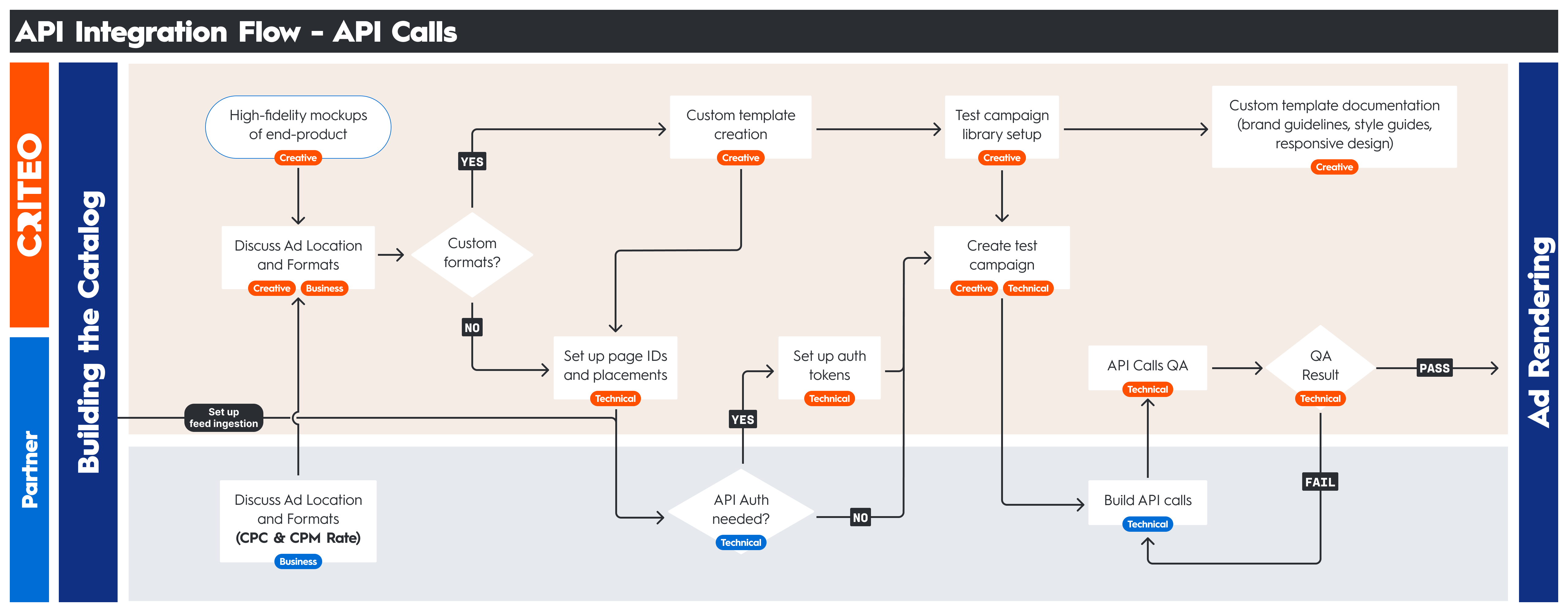
Ad server API calls integration process
Where to Make API Calls
Our API recognizes the following page types:
- Search: Pages where users perform a keyword search, including the search bar dropdown.
- Category: Includes category pages, category menu fly outs, and deals/promotional pages.
- Product detail (PDP): Individual product pages.
- Homepage: The main landing page of your site.
- Checkout/Cart/Basket: Pages where users review their cart or initiate checkout.
- Order confirmation: Pages confirming a transaction or purchase.
There is also a special "page type" called add-to-cart. In practice, this is not a dedicated page, but an event used to build our keyword model. More information about the keyword model can be found here.
Each page type is linked to valid values of the event-type parameter in the API call. More details can be found at API Parameters.
General Ad Server Requirements
You can find the general ad server requirements here.
Recommended API Call Practices
Make Ad Calls on Every Page Load
Whenever possible, implement API calls on every page load to ensure comprehensive data collection, accurate attribution, and optimal ad delivery.
This documentation does not distinguish between
mandatoryandrecommendedevents. Each event contributes differently to performance, attribution, and data completeness.
While some events are described below as recommended, many of them are critical for correct performance, attribution, and model accuracy. Not implementing these events may lead to:
- degraded campaign performance
- incomplete attribution
- incorrect product recommendations
Understanding the Value of Each Page Type
If calling the API on all page types is not feasible, the descriptions below explain the role of each page type and the impact of not implementing it.
Search pages
Capture strong intent signals based on user-entered keywords. Search pages significantly contribute to building and optimizing the keyword model for Sponsored Products. Even if you do not plan to show ads on search pages, integrating them (along with PDP and Add-to-cart events) is recommended.
Category pages
Provide mid-funnel browsing signals and help Criteo understand product discovery behavior across your catalog. When used together with Search pages, Category integrations give the algorithm a fuller view of the user journey, even if ads are not displayed on these pages.
Add-to-cart events
Essential when your e-commerce platform allows users to add products directly to the cart without first visiting the product detail page. These events supply strong purchase-intent signals, improve the keyword model, and allow you to build audiences based on cart activity.
Product detail pages
Provide detailed product-level engagement signals and enable real-time updates on product availability and pricing. Without this event, there is a risk of outdated product information appearing in ad responses, including out-of-stock products. Implement this event even if ads are not displayed on product detail pages.
Transaction pages
Enable accurate attribution and are required for a functioning integration. Missing transaction events will prevent conversion tracking and significantly impact optimization and reporting.
Homepage
Often has the highest traffic volume and can support campaigns relying on broad audience reach and post-view attribution.
Checkout pages
Provide visibility into cart contents and help improve product recommendation logic for users nearing purchase.
API Endpoints
Criteo’s Retail Media ad delivery system offers three distinct endpoints, each tailored to specific regions. These endpoints ensure that the closest data center is utilized based on the location of your servers.
Endpoint Structure
- Host:
d.[region].criteo.com- Supported regions:
- EMEA:
eu - AMERICAS:
us - APAC:
as
- EMEA:
- Supported regions:
- Path:
/delivery/retailmedia - Scheme: Always
https - Query Parameters: Described in [API Parameters](doc:api-parameters-1
Possible Endpoints
- EMEA:
https://d.eu.criteo.com/delivery/retailmedia?[parameters] - AMERICAS:
https://d.us.criteo.com/delivery/retailmedia?[parameters] - APAC:
https://d.as.criteo.com/delivery/retailmedia?[parameters]
Usage Guidelines
- Use the endpoint based on where your API calls will originate, not where your users or your frontend are located.
- If you are unsure of which endpoint to use, please ask your technical account manager for guidance.